Arc de Triomphe
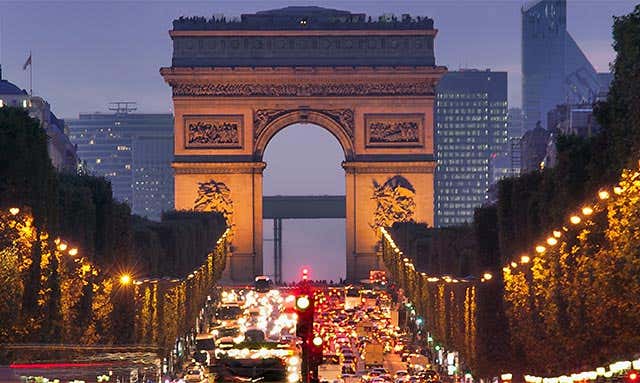
The Arc de Triomphe is an emblematic symbol of the capital of France and it represents the various victories of the French army under Napoleon, who commissioned its construction.
The Arc de Triomphe is, along with the Eiffel Tower, one of the main symbols of Paris. It stands 146 ft (50 m) tall, 148 ft (45 metres) wide, and 72 ft (22 m) deep. The monument represents all the French military victories in the Napoleonic Wars.
Designed by Jean-François Chalgrin, the Arc took thirty years to build. It was commissioned by Napoleon in 1806 at the end of the Battle of Austerlitz and inaugurated by King Louis-Philippe.
The Arc de Triomphe has witnessed the city’s most relevant turning points, including Napoleon’s funeral on December 15th, 1840, the World War I victory parade in 1919, and the “Victory Day” parade to celebrate the end of World War II in 1944.
The base of the Arc de Triomphe
At the base of the Arc is the Tomb of the Unknown Soldier, erected in 1921. With a burning flame, it represents all French soldiers who died during World War I and were never identified.
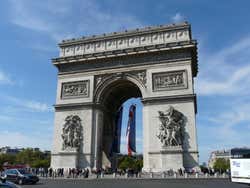
Each of the four pillars represents important victories, such as the French resistance during the War of the Sixth Coalition in 1814, the Treaty of Paris in 1815, La Marseillaise, and the Treaty of Schonbrunn in 1810.
Every day at 6:30 pm, war veterans hold an official flame relighting ceremony. It's a very solemn, free, and moving moment to witness from the base.
Visiting the Arc de Triomphe
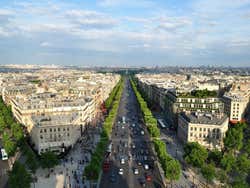
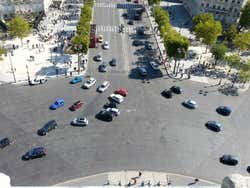
Although this Roman-inspired arch doesn’t stand as high as the Eiffel Tower, its views are equally breathtaking. Another reason to climb to the top is to see the meeting point of the city’s twelve avenues in the same Place Charles de Gaulle. Lastly, the views of the Champs-Élysées and La Défense neighbourhood are striking from this spot.
Para entrar al interior del arco y subir a la parte superior es necesario pagar una entrada y subir los 286 escalones que separan la terraza del suelo (hay un ascensor para personas de movilidad reducida). En el interior también veremos un pequeño museo y datos sobre su construcción.
To enter the Arc de Triomphe and climb to the top, you need to pay an entrance fee and ascend the 286 steps that separate the terrace from the ground (there is an elevator for people with reduced mobility). Inside, you'll also find a small museum and information about its construction.
The view towards La Défense (the financial district) from the top is spectacular because the Arc de Triomphe is perfectly aligned with the Grande Arche de la Défense. It's the ideal place to understand the historical "Grand Axis" of Paris.
How to Reach the Arc de Triomphe?
To get to the base of the Arc du Triomphe, you'll have to take the underpass on the Champs-Élysées. Do not try to cross the roundabout, as this is one of the most dangerous in the world.
Schedule
From April 1 to September 30:
Wednesday to Monday (10 am to 11 pm)
Tuesday (11 am to 11 pm)
From October 1 to March 31:
Wednesday to Monday (10 am to 10:30 pm)
Tuesday (11 am to 10:30 pm)
Closed: January 1, May 1, May 8 (morning), July 14 (morning), November 11 (morning), December 24 (early), December 25, and December 31 (early).
Price
Adults: € 16 (US$ 17.94)
Children under 18 years old, European Union nationals between 18 and 25 years old, disabled people, and accompanying people: free admission
First Sunday in January, February, March, November, and December: free admission
Free admission with the Paris Pass and Paris Museum Pass.
Arc de Triomphe Tickets € 16 (US$ 17.94)
Transport
Metro: Charles de Gaulle - Etoile, lines 1, 2 and 6
RER: Charles de Gaulle - Etoile, line A
Bus: lines 22, 30, 31, 52, 73 and 92
Nearby places
Musée Guimet (970 m) Musée d’Art Moderne (1 km) Musée des égouts de Paris (1.4 km) Champs-Élysées (1.4 km) Musée Nissim de Camondo (1.4 km)